

5G Chipset Market Poised for Rapid Growth to Reach USD 177.30 Billion by 2035
5G Chipset Market
5G Chipset Market is expanding as smartphones, IoT devices, and connected infrastructure drive demand for faster, low-latency connectivity.
5G chipsets are becoming essential to next-generation connectivity, enabling faster data speeds, lower latency, and smarter connected devices across industries worldwide.”
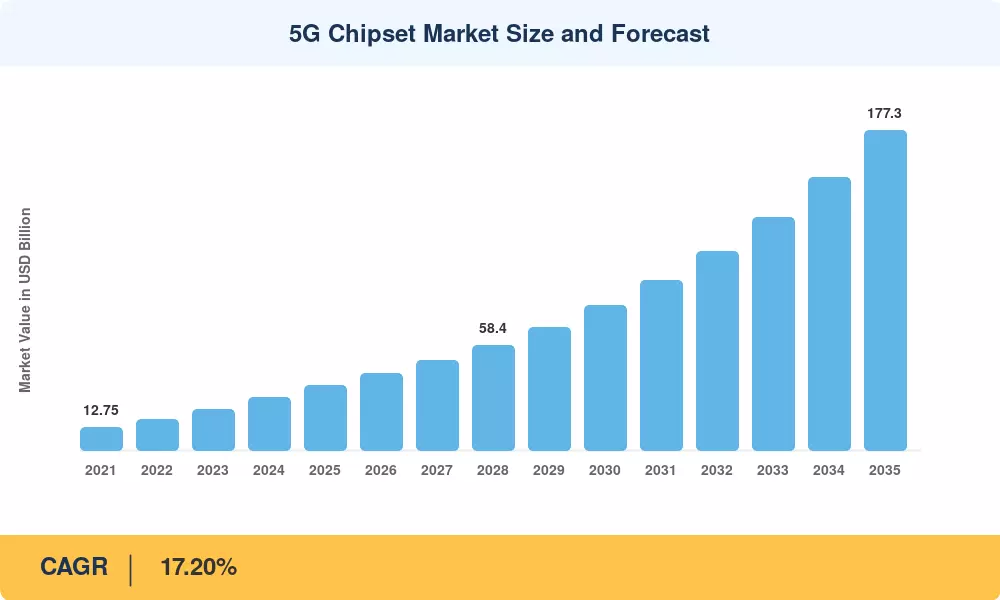
PARIS, PARIS, FRANCE, August 27, 2026 /EINPresswire.com/ -- The 5G Chipset Market is expanding rapidly as telecom operators, smartphone manufacturers, automotive companies, and industrial organizations accelerate investments in next-generation connectivity. According to Market Research Future, the market reached an estimated USD 36.20 billion in 2025 and is projected to grow from USD 42.50 billion in 2026 to USD 177.30 billion by 2035, registering a 17.20% CAGR throughout the forecast period. — Market Research Future
The growth is being supported by standalone 5G network deployment, increasing smartphone adoption, private 5G networks, edge computing, and demand for faster and more energy-efficient semiconductor solutions. The transition toward advanced semiconductor nodes is also improving chipset performance while reducing power consumption. Government-backed semiconductor initiatives in the United States, Europe, and India are encouraging domestic manufacturing and strengthening supply-chain resilience.
The market is also moving beyond smartphones. Industrial automation, connected vehicles, fixed wireless access, smart infrastructure, and edge-AI applications are creating new demand for specialized 5G silicon. As standalone 5G networks become more widespread, network operators require upgraded baseband processors, radio-frequency components, networking ASICs, and other specialized chipsets.
Meanwhile, Open RAN architectures are creating opportunities for programmable and merchant silicon. The growing integration of artificial intelligence directly into network and device chipsets is another important trend. These developments are turning 5G chipsets into multifunctional computing platforms capable of supporting connectivity, intelligence, and real-time processing across a growing range of applications.
Get a Sample PDF of the Report at -
https://www.marketresearchfuture.com/sample_request/7148
Market Dynamics: Drivers, Restraints and Opportunities
The transition toward standalone 5G networks is one of the strongest growth drivers for the 5G Chipset Market. Unlike non-standalone deployments, standalone architectures enable advanced capabilities such as network slicing, ultra-reliable low-latency communication, and improved edge-computing integration. These capabilities require upgraded processing silicon across base stations, user equipment, and networking infrastructure. The proliferation of private 5G networks in manufacturing, mining, logistics, ports, and other industrial environments is creating additional demand for ruggedized and specialized chipsets.
The semiconductor industry's migration toward sub-3 nm technology nodes is another major driver. Smaller process technologies can deliver better performance and power efficiency, making them increasingly attractive for premium smartphones, networking equipment, and AI-enabled edge devices. Government semiconductor incentives are further strengthening the market by encouraging new fabrication facilities and reducing dependence on concentrated global supply chains. The U.S. CHIPS and Science Act, European Chips Act, and India's semiconductor incentive programs are supporting investments in domestic semiconductor ecosystems.
However, the industry faces significant restraints. Geopolitical tensions and semiconductor export controls can disrupt international supply chains and increase compliance costs. Concentration of advanced foundry capacity creates additional supply risks, while volatility in critical materials such as gallium and germanium can affect RF component production. Rising research and development costs are another challenge because advanced chipset designs require substantial engineering resources, sophisticated fabrication processes, and lengthy testing cycles. Spectrum allocation delays in some countries can also slow the deployment of networks that would otherwise generate chipset demand.
Several emerging opportunities could reshape the competitive landscape. Open RAN chipset diversification is opening the market to merchant silicon providers by separating network functions that were traditionally integrated into proprietary platforms. Edge-AI inference is creating demand for chipsets that combine 5G connectivity with dedicated neural-processing capabilities. Non-terrestrial network technology is another promising area, particularly as direct-to-device satellite connectivity develops. Emerging markets across Africa and Southeast Asia also offer long-term opportunities as operators expand 5G coverage and governments release additional spectrum.
Key Players and Competitive Insights
The 5G Chipset Market includes semiconductor manufacturers, networking-silicon companies, modem developers, and adaptive-computing specialists. Key players include Qualcomm, MediaTek, Samsung Electronics, Broadcom, Marvell Technology, and Intel/Altera. AMD/Xilinx, Huawei/HiSilicon, Unisoc, and Nokia are also important participants across different parts of the ecosystem.
Qualcomm maintains a strong position through its integrated modem-to-RF platforms and Snapdragon product family. MediaTek competes strongly in smartphone chipsets, particularly across high-volume and cost-sensitive categories. Samsung benefits from vertical integration across chipset development and semiconductor manufacturing. Broadcom and Marvell have strong positions in networking infrastructure, switching, processing, and data-center-oriented silicon. Intel/Altera and AMD/Xilinx are particularly relevant to programmable and adaptive architectures supporting Open RAN and virtualized network infrastructure.
Competition is increasingly shifting toward AI integration, energy efficiency, advanced packaging, programmable architectures, and multi-band support. Vendors are also developing solutions capable of supporting both traditional cellular applications and emerging use cases such as satellite connectivity, industrial automation, connected vehicles, and edge computing.
Regional Insights
Asia-Pacific leads the global 5G Chipset Market, accounting for approximately 44.20% of market revenue in 2025. The region benefits from strong semiconductor manufacturing capabilities, major smartphone production ecosystems, extensive operator investments, and large technology markets in China, South Korea, Japan, and India. Asia-Pacific is also projected to expand at a 17.90% CAGR through 2035.
North America represented approximately 28.00% of the market in 2025. Strong investment in 5G infrastructure, mmWave deployment, fixed wireless access, defense applications, and semiconductor manufacturing is supporting regional growth. U.S. government semiconductor incentives are also encouraging new domestic production capacity.
Europe accounted for approximately 18.50% of revenue in 2025. The region is emphasizing Open RAN development, automotive connectivity, industrial automation, and semiconductor supply-chain resilience. The European Chips Act is supporting investments in advanced semiconductor manufacturing and packaging.
South America and the Middle East & Africa represent emerging opportunities. Spectrum expansion, fixed wireless access, smart-city initiatives, and increasing digital connectivity are expected to support future chipset demand.
Buy this Premium Research Report at:
https://www.marketresearchfuture.com/checkout?currency=one_user-USD&report_id=7148
Market Segmentations
The 5G Chipset Market can be segmented as follows:
By Chipset Type
· Application-Specific Integrated Circuits (ASICs)
· System-on-Chip with Integrated Modem
· FPGAs
· RFICs and Front-End Modules
· Others
By Technology Node
· Sub-3 nm
· 3 nm
· 5 nm
· 7 nm
· 16 nm
· 28 nm
· Above 28 nm
By Operational Frequency
· Sub-6 GHz
· 26–39 GHz
· Above 39 GHz
By End-User Industry
· Consumer Electronics
· IT, Telecom & Network Infrastructure
· Industrial Automation
· Automotive & Transportation
· Healthcare, Energy & Defense
· Other Industries
By Region
· North America
· Europe
· South America
· Asia-Pacific
· Middle East & Africa
ASICs held the largest chipset-type share at approximately 27.20% in 2025, supported by demand for carrier-grade network infrastructure. FPGAs are projected to grow at an 18.50% CAGR, benefiting from programmable architectures and Open RAN deployments. By technology node, 5 nm represented approximately 29.00% of the market, while sub-3 nm is forecast to grow at a 21.50% CAGR. Sub-6 GHz remained dominant by operational frequency, holding around a 54.10% share, while frequencies above 39 GHz are projected to grow rapidly as fixed wireless access and high-density deployments expand.
Browse In-depth Market Research Report:
https://www.marketresearchfuture.com/reports/5g-chipset-market-7148
Recent Developments
Recent developments in the 5G Chipset Market are increasingly focused on AI-enabled modems, satellite connectivity, advanced semiconductor manufacturing, Open RAN, and specialized networking processors. Qualcomm introduced the Snapdragon X80 modem-RF system with AI-assisted carrier aggregation and satellite connectivity capabilities, highlighting the industry's movement toward intelligent and versatile connectivity platforms. MediaTek has also expanded its premium chipset portfolio with advanced 3 nm architectures.
Samsung has been developing modem technology supporting direct-to-satellite connectivity, while Marvell has expanded its networking processor portfolio for 5G infrastructure and user-plane processing. Semiconductor manufacturing investments are also accelerating, with major programs in the United States, Europe, and India supporting domestic production capacity.
Open RAN continues to create opportunities for programmable silicon because operators increasingly seek more flexible and interoperable network infrastructure. At the same time, AI-enabled edge processing is encouraging chipset manufacturers to integrate dedicated acceleration engines alongside cellular connectivity. These developments are expected to expand the role of 5G chipsets from simple communication components into intelligent processing platforms for connected devices, networks, vehicles, factories, and infrastructure.
Frequently Asked Questions:
Q1. What is the 5G Chipset Market?
It covers semiconductor components used to enable 5G connectivity across smartphones, networks, vehicles, industrial systems, and connected devices.
Q2. What was the market size in 2025?
The market reached approximately USD 36.20 billion in 2025.
Q3. What will the market reach by 2035?
It is projected to reach approximately USD 177.30 billion by 2035.
Q4. What is the expected CAGR?
The market is projected to expand at a 17.20% CAGR through 2035.
Q5. Which region leads the market?
Asia-Pacific leads, accounting for approximately 44.20% of 2025 revenue.
Q6. Which chipset type dominates?
ASICs held the largest share, accounting for approximately 27.20% in 2025.
Q7. What is driving market growth?
Standalone 5G deployment, private networks, advanced semiconductor nodes, AI integration, and connected-device growth are major drivers.
Q8. Who are the major players?
Qualcomm, MediaTek, Samsung Electronics, Broadcom, Marvell Technology, and Intel/Altera are among the leading participants.
➤➤ Regional & Country-Level Reports by Market Research Future:
Us 5G Chipset Market -
https://www.marketresearchfuture.com/reports/us-5g-chipset-market-17888
➤➤ Featured Insights from Market Research Future:
Compensation Management Software Market -
https://www.marketresearchfuture.com/reports/compensation-management-software-market-31173
Course Authoring Software Market -
https://www.marketresearchfuture.com/reports/course-authoring-software-market-31187
Blockchain In Agriculture And Food Supply Chain Market -
https://www.marketresearchfuture.com/reports/blockchain-in-agriculture-and-food-supply-chain-market-31200
Transportation Analytics Market -
https://www.marketresearchfuture.com/reports/transportation-analytics-market-31216
Piezoelectric Elements Market -
https://www.marketresearchfuture.com/reports/piezoelectric-elements-market-31243
Instaprint Camera Market -
https://www.marketresearchfuture.com/reports/instaprint-camera-market-31317
Regulatory Information Management Market -
https://www.marketresearchfuture.com/reports/regulatory-information-management-market-31320
Data Center Robotics Market -
https://www.marketresearchfuture.com/reports/data-center-robotics-market-31324
Beacons Management Software Market -
https://www.marketresearchfuture.com/reports/beacons-management-software-market-31473
Market Research Future
Market Research Future
+ +1 855-661-4441
email us here
Legal Disclaimer:
EIN Presswire provides this news content "as is" without warranty of any kind. We do not accept any responsibility or liability for the accuracy, content, images, videos, licenses, completeness, legality, or reliability of the information contained in this article. If you have any complaints or copyright issues related to this article, kindly contact the author above.
