

In-Vitro Fertilization Market to reach USD 55.94 Billion by 2035 at 7.70% CAGR
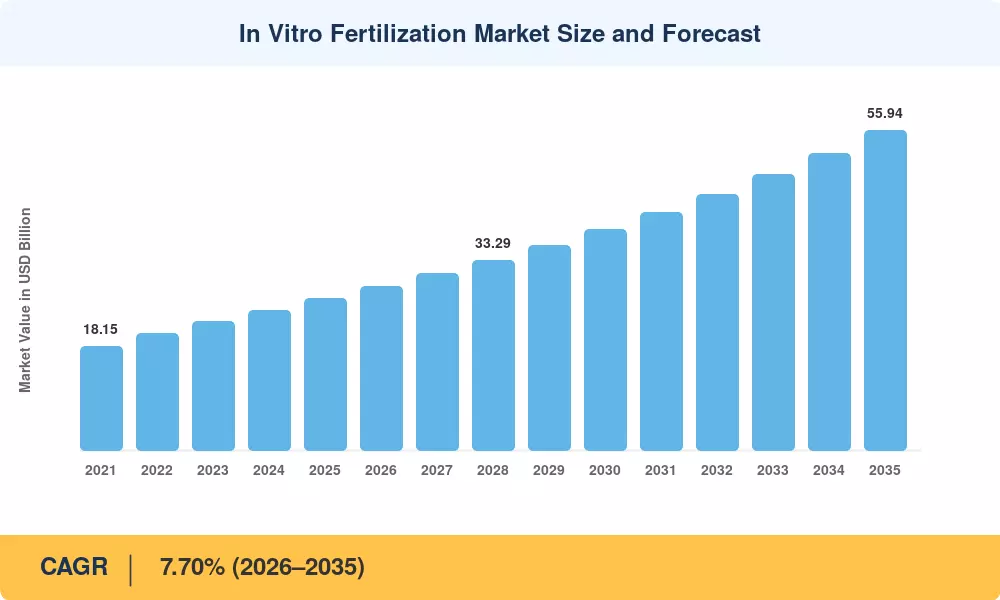
In-Vitro Fertilization (IVF) Market (2026 - 2035)
In-Vitro Fertilization Market to Expand from USD 26.65 Billion in 2025 to USD 55.94 Billion by 2035---Powered by Rising Maternal Age, Employer Benefit Expansion
NY, CA, UNITED STATES, September 8, 2026 /EINPresswire.com/ -- As per Market Research Future, the global In-Vitro Fertilization Market size is projected to reach USD 55.94 Billion by 2035 from USD 26.65 Billion in 2025, at a CAGR of 7.70% during the forecast period 2026--2035. The market closed 2025 at roughly USD 26.65 Billion.The 7.70% CAGR---anchored by structural shifts in assisted reproductive technology---is propelled by four converging forces: the rising global maternal age at first birth and increasing infertility prevalence, with the WHO estimating roughly one in six adults worldwide experiences infertility, driving demand for advanced fertility treatments; expansion of employer-funded fertility benefits and national health insurance coverage for assisted reproduction, with approximately 47% of large US employers now funding fertility benefits and Japan folding ART into national health insurance; advancements in laboratory automation and embryo assessment technologies, including time-lapse imaging, AI-assisted grading, and vitrification protocols that have displaced slow-freeze methods almost entirely; and the rapid adoption of preimplantation genetic testing, which now touches a third of cycles in mature markets, lifting revenue per cycle while improving outcomes.
Global pharmaceutical and medical device companies are amplifying this momentum. Vitrolife Group continues advancing integrated software-layer differentiation through algorithmic embryo ranking deployment across European clinics. CooperSurgical broadened its fertility segment scale through the integration of Cook Medical's reproductive health assets. Merck KGaA announced a digital fertility platform partnership pairing stimulation protocol analytics with clinic outcome dashboards. According to WHO data, roughly one in six adults experiences infertility globally, while Mercer's 2025 survey placed fertility coverage at 47% of employers with 500+ staff. These forces are creating the clinical infrastructure and patient demand on which the In-Vitro Fertilization Market depends.
Request A Free Sample:
https://www.marketresearchfuture.com/sample_request/2289
Key Market Trends & Growth Drivers
Rising Demand for Fertility Preservation and Delayed Parenthood
The market is witnessing increasing demand for fertility treatments as maternal age at first birth rises globally and infertility prevalence grows. More individuals and couples are seeking effective assisted reproductive interventions, with elective oocyte banking and oncofertility referrals growing faster than treatment cycles. This trend indicates a shift in consumer attitudes towards proactive fertility management, with IVF being recognized for its established efficacy in addressing both male-factor and female-factor infertility. Vitrolife continues advancing product development through next-generation time-lapse incubators and algorithmic embryo assessment technologies.
Advancements in Laboratory Automation and Cryopreservation
Innovations in laboratory workflows are becoming a hallmark of the industry. Fertility clinics are replacing manual, judgment-heavy workflows with time-lapse imaging, closed-culture systems, electronic witnessing, and algorithmic ranking of embryo development. Vitrification has displaced slow-freeze protocols almost entirely, and preimplantation genetic testing now touches a third of cycles in mature markets. These advancements aim to enhance clinical outcomes and operational efficiency, potentially leading to higher live-birth rates and increased market penetration. Frozen IVF cycles are advancing at a 9.4% CAGR as freeze-all protocols become default practice.
Expansion of Employer Benefits and National Reimbursement
The incorporation of fertility coverage into employer health plans and national insurance schemes is gaining traction. In the United States, roughly 47% of large employers now fund fertility benefits, up from 30% five years earlier, with median annual benefit caps near USD 25,000. Japan's decision to fold assisted reproduction into national health insurance removed a five-figure yen barrier for hundreds of thousands of couples, and within two years, registered cycles exceeded 540,000. China added ART items to basic medical insurance coverage in over 25 provinces by mid-2025. CooperSurgical continues investing in fertility clinic platform consolidation and multi-site standardization.
Increasing Prevalence of Infertility and Advanced Maternal Age
The rising incidence of infertility and delayed childbearing is a primary driver. According to WHO, roughly one in six adults worldwide experiences infertility, with advanced maternal age and lifestyle factors contributing significantly. The market is projected to expand as healthcare providers increasingly prescribe IVF and associated procedures to manage fertility challenges. The World Health Organization has identified infertility as a major public health concern, underscoring the urgent need for innovative and accessible solutions.
Ask for Customization:
https://www.marketresearchfuture.com/ask_for_customize/2289
Market Segment Insights
BY PRODUCT
Reagents & Media: Largest segment with 41.8% share in 2025, driven by per-cycle consumption and lot-to-lot validation requirements that create high switching costs. Vitrolife continues expanding media and reagent portfolios through sustained product innovation.
Instruments: Significant segment valued at USD 9.67 Billion in 2025, driven by incubator and micromanipulator replacement cycles as clinics upgrade to multi-chamber time-lapse systems.
Consumables & Disposables: Fastest-growing segment at an 8.3% CAGR, as single-use closed systems replace reusable glassware, enhancing laboratory safety and standardization.
BY CYCLE TYPE
Fresh IVF Cycles -- Non-Donor: Largest segment with 36.2% share in 2025, representing the standard first-line protocol for most patients.
Frozen IVF Cycles -- Non-Donor: Fastest-growing segment at a 9.4% CAGR, as freeze-all strategies become default practice and vitrification survival rates exceed 95%.
Fresh IVF Cycles -- Donor: Significant segment valued at USD 4.61 Billion in 2025, driven by advanced maternal age and established donor programs.
BY PROCEDURE TYPE
IVF with ICSI: Largest segment with 45.6% share in 2025, reflecting elevated male-factor infertility diagnosis rates and clinic preference for fertilization certainty.
Conventional IVF: Significant segment valued at USD 7.44 Billion in 2025, serving as a cost-sensitive first-line treatment option.
IVF with PGT/PGD: Fastest-growing procedure type at a 10.2% CAGR, driven by aneuploidy screening demand in older patient cohorts and rising genetic testing attachment rates.
BY END USER
Fertility Clinics: Dominant end-user segment with 68.4% share in 2025, benefiting from dedicated embryology labs, specialist staffing, and volume-dependent outcome correlations.
Hospitals: Significant segment valued at USD 5.12 Billion in 2025, retaining relevance for oncofertility and complex comorbidity cases requiring multidisciplinary support.
Clinical Research Institutes: Fastest-growing end-user segment at an 8.9% CAGR, driven by protocol trials, embryology training, and outcome data commercialization.
Read Detailed Insights:
https://www.marketresearchfuture.com/reports/in-vitro-fertilization-market-2289
Regional Outlook
North America --- Market Leader in Innovation
North America leads with 38.5% of global revenue in 2025, generating around USD 10.26 Billion. The region's growth is driven by employer-funded fertility benefit expansion, state insurance mandates, and high PGT attach rates. Twenty-two US states now impose some form of infertility insurance mandate, and the 2024 addition of IVF coverage for federal employees under FEHB extended benefits to roughly 8 million lives. The competitive landscape is characterized by continuous clinic consolidation and technology adoption among leading fertility networks.
Europe --- Second Largest Market
Europe was valued at USD 7.20 billion in 2025, representing the second-largest regional market. The region benefits from mixed public-private funding models, cross-border care flows, and supportive regulatory frameworks. France's revised bioethics law opened treatment to single women and female couples, adding an estimated 25,000 annual cycles by 2024. Spain remains the continent's donor hub, handling a disproportionate share of cross-border cycles. Leading countries include Germany, the UK, France, and the Nordic states, where major suppliers such as Vitrolife and Merck KGaA are heavily invested.
Asia-Pacific --- Rapidly Growing Market Segment
The Asia-Pacific region compounds at a 9.6% CAGR, the fastest of any region. The growth is driven by provincial reimbursement expansion, clinic formalization, and low-cost protocol adoption. China's addition of ART items to basic medical insurance in over 25 provinces has driven cycle volumes up 20--35% within a year of listing. India's ART (Regulation) Act has forced informal centres to register or close, consolidating demand into branded chains. Japan's national health insurance coverage has pushed registered cycles beyond 540,000 annually.
Middle East and Africa --- Untapped Potential
The MEA region holds a smaller but growing share of the global market, valued at approximately USD 0.93 Billion in 2025. Growth is driven by sovereign health privatization programs, medical tourism corridors, and rising awareness of infertility treatment. Saudi Arabia's Vision 2030 health privatization has licensed dozens of new fertility centres, while Egypt serves as a cost-advantaged regional treatment hub, pricing cycles at 40--60% of European rates. The competitive landscape is evolving with increasing presence of international clinic operators and suppliers.
Competitive Landscape and Recent Developments
The In-Vitro Fertilization market is characterized by moderate concentration and rapid technological change, driven by increasing global demand for assisted reproduction. The global industry appears moderately fragmented, with several key players exerting significant influence across media, instruments, and devices.
KEY COMPANIES AND RECENT MILESTONES
Vitrolife Group (SE): Holds an estimated 11--14% revenue share. Launched an expanded iDAScore deployment across European clinics in March 2024, extending algorithmic embryo ranking to routine practice and reinforcing software as a differentiator. Broad-line leader with integrated media, time-lapse incubators, and PGT services.
CooperSurgical (US): Holds an estimated 10--13% revenue share. Completed integration of Cook Medical's reproductive health assets in September 2023, broadening its retrieval and transfer device line and lifting fertility segment scale. Acquisition-led portfolio breadth spanning media, disposables, witnessing, and genomic testing.
Merck KGaA (DE): Holds an estimated 8--11% revenue share. Announced a digital fertility platform partnership in November 2024, pairing stimulation protocol analytics with clinic outcome dashboards. Pharma-anchored player with upstream protocol influence through gonadotropins and fertility software.
FUJIFILM Irvine Scientific (US/JP): Holds an estimated 6--8% revenue share. Competes on manufacturing scale and lot consistency in culture media and cryopreservation solutions.
Thermo Fisher Scientific (US): Holds an estimated 5--7% revenue share. Leverages genomics-adjacent entry point through sequencing for PGT, lab consumables, and cold chain infrastructure.
Other Key Players: Genea Biomedx (AU), Kitazato Corporation (JP), Esco Medical (SG), Hamilton Thorne (US), Cook Medical (US), Ferring Pharmaceuticals (CH), INVO Bioscience (US).
Future Outlook: 2026--2035
The In-Vitro Fertilization Market is projected to reach USD 55.94 billion by 2035, growing at a CAGR of 7.70%, driven by rising infertility prevalence, expanding reimbursement coverage, and advancements in laboratory automation and genetic testing.
New opportunities lie in:
Expansion into emerging markets with low-cost cycle models and simplified protocols
Development of AI-assisted embryo selection and algorithmic grading to reduce inter-operator variability
Investment in cryostorage infrastructure and fertility preservation services beyond infertility treatment
Platform economics and clinic consolidation to centralize procurement and standardize outcomes
By 2035, the In-Vitro Fertilization Market is expected to achieve substantial growth and innovation, transforming from a network of boutique clinics into a standardized, data-instrumented specialty care industry.
More Related Research Insights:
https://www.marketresearchfuture.com/fr/reports/life-science-analytical-instruments-market-825
https://www.marketresearchfuture.com/ja/reports/life-science-analytical-instruments-market-825
https://www.marketresearchfuture.com/de/reports/life-science-analytical-instruments-market-825
https://www.marketresearchfuture.com/fr/reports/bone-graft-substitutes-market-1195
https://www.marketresearchfuture.com/ja/reports/bone-graft-substitutes-market-1195
https://www.marketresearchfuture.com/de/reports/bone-graft-substitutes-market-1195
https://www.marketresearchfuture.com/fr/reports/chemiluminescence-immunoassay-analyzers-market-8783
https://www.marketresearchfuture.com/ja/reports/chemiluminescence-immunoassay-analyzers-market-8783
https://www.marketresearchfuture.com/de/reports/chemiluminescence-immunoassay-analyzers-market-8783
https://www.marketresearchfuture.com/es/reports/chemiluminescence-immunoassay-analyzers-market-8783
Market Research Future
Market Research Future
+1 855-661-4441
email us here
Legal Disclaimer:
EIN Presswire provides this news content "as is" without warranty of any kind. We do not accept any responsibility or liability for the accuracy, content, images, videos, licenses, completeness, legality, or reliability of the information contained in this article. If you have any complaints or copyright issues related to this article, kindly contact the author above.
